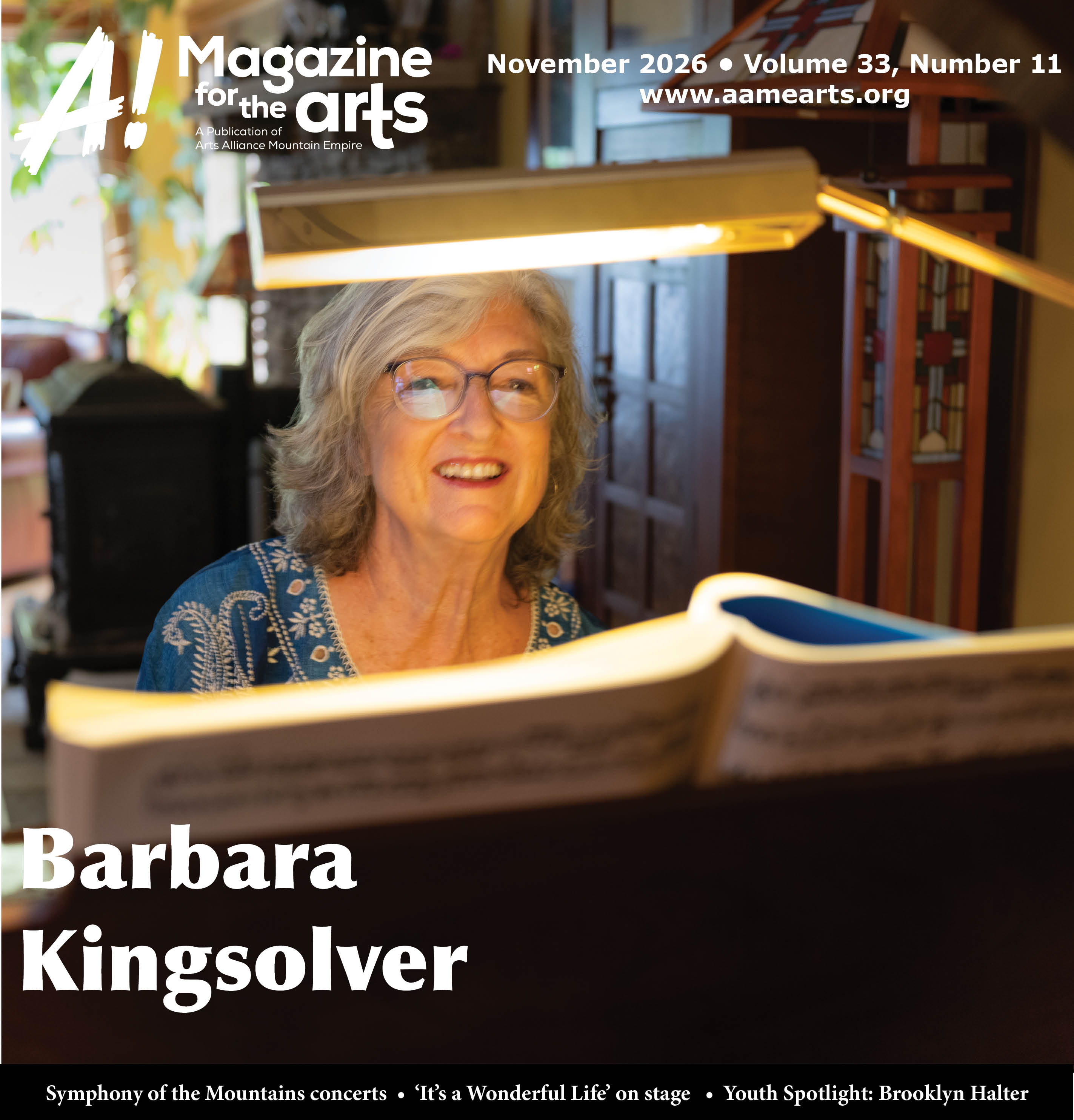
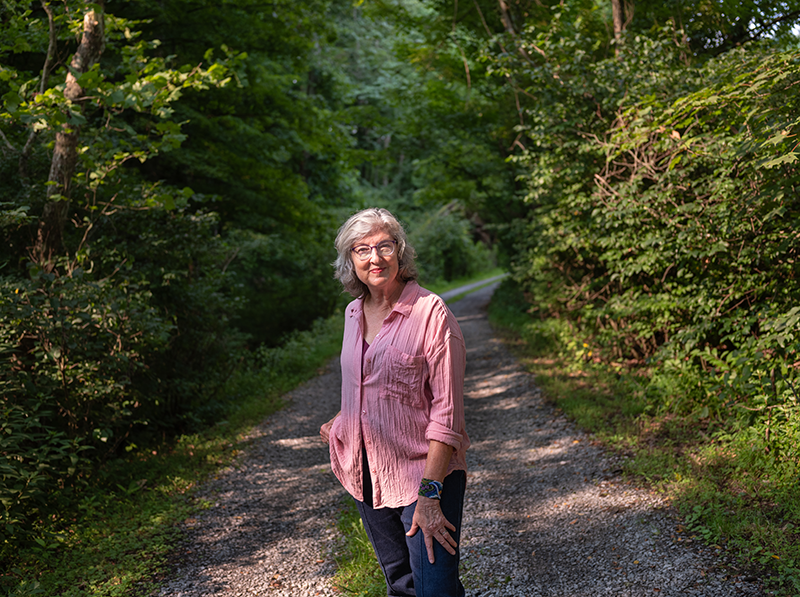
Barbara Kingsolver (photo by Irina Rozovsky)
Barbara Kingsolver was kind enough to answer questions for “A! Magazine for the Arts” about her new novel “Partita” as well as her writing methods and winter reading tips on books that she has recently enjoyed.
A! Magazine: Tell us why you chose the musical term “Partita” for the title of your new novel and discuss how it relates especially to the structure of the book.
Kingsolver: Partita is a musical composition made of many parts with different moods: fast, slow, flirtatious, reserved, joyous, mournful. The challenge for the musician is to bring all the parts together in the performance, so they add up to something that feels whole.
The protagonist of my novel is a classical pianist, and her life — like most — has had parts that were happy, or passionate, and others that were tragic. The novel begins with a shocking phone call that makes her look back on all these parts, trying to understand how they add up. The novel, like a Bach Partita, is told in chapters with musical titles moving back and forth through time, through the highs and lows, like a musical composition in words. You don’t really have to know this to enjoy reading it, but I enjoyed building the metaphor. The thrill of literary fiction is to try to tell a story in a whole new way, as its own perfect construction.
A! Magazine: The book is filled with musical references: the book’s title, chapter titles and you even provided a listening list. How much musical knowledge did you have going into this book and how much did you have to research? (Were your youthful plans initially to become a concert pianist?)
Kingsolver: I’ve loved music all my life, and played a lot of instruments — piano, bass clarinet, drums, synthesizer — in everything from marching band to rock and roll and jazz bands. But classical piano is my first and lasting love; as a teenager, I worked hard enough at it to win a music scholarship to college. There, I quickly figured out I lacked the single-minded dedication and skills to succeed as a concert pianist, so I took other classes and eventually majored in biology. Still, I know enough about that world to represent it authentically.
One of many challenges of writing fiction is that every character has to have a livelihood or special knowledge of some kind, and as the author, you have to back it up. Obviously, we do a lot of research (watch out for me if I learn you have an interesting job, for I will interrogate you!), but it’s natural to draw from our own wells of experience, too. Across 10 novels and lots of short stories, I’ve written about farmers, scientists, railroad engineers, doctors, preachers, housecleaners, delinquent kids, writers and other kinds of artists, you name it. I’m not sure why it took me this long to take a deep dive into the world of music and its creation, but I loved it.
A! Magazine: “Partita” follows the life journey of its central character, Livia Bohusz, from adolescence to middle age. Central to the book are the loves (and passions) of Livia’s life — in all of the ways that love can mean. How did you see “love” as you were writing this story?
Kingsolver: That’s such a good question. In the beginning, I was conscious of the big response to “Demon Copperhead,” my ambitious attempt to write the Great Appalachian Novel. I wanted to follow it with something that couldn’t be compared. Something small was my thinking: intimate and self-contained. A little love story. A young pianist, falling insanely in love with a man who can’t quite understand her feelings for music. But as I looked back on my own unhinged experiences of young love (haven’t we all?), I kept thinking of how much I’ve learned in the decades since. Mature love is so different, tempering those early fires with the quieter graces of acceptance, loyalty and forgiveness. I started wrapping my little love story inside a bigger one. And then I realized I needed to wrap this double package in an even bigger kind of love, the craving we humans have surely felt since our ancestors first painted a cave wall or raised their voices in song: the eternal human reach for art and beauty. I think it’s all connected.
A! Magazine: Novelists in creating characters have to be amateur psychologists. In this book you explore how childhood trauma affects one’s adult life. What are your thoughts on this developmental issue? In the book, a character comments about “the nightmare that childhood is.”
Kingsolver: You’re right, it takes a thorough understanding of psychology to create multidimensional characters who behave in convincing ways. Actually, we’re not amateurs; we make our living at this! But instead of helping to fix troubled people, we work backwards, starting with fully formed, often dysfunctional characters and inventing their histories all the way back to childhood, giving them exactly the kinds of damage that would make them behave as they do. Every injury doesn’t go onto the page, but it all has to be mapped out and somehow implied.
So yes, over my career I’ve done an enormous amount of reading about trauma, post-traumatic stress, attachment disorders and so forth. An important character in this novel is a hoarder, so I studied the relevant academic literature on that too. But I think most of what I know about people and our problems comes from being one and living among them, paying close attention. Almost all the novelists I know are introverts: we’re not the big talkers, movers and shakers. We’re the quiet watchers, forever fascinated with figuring out what makes people tick.
A! Magazine: The epigraph to “Partita” is from Toni Morrison: “Sometimes you don’t survive whole, you just survive in part. But the grandeur of life is that attempt.” Is the book a summing up of your philosophy of life as you enter your “mature years”?
Kingsolver: I am so lucky to have 70 years of life experience to bring to work every day. I feel badly for dancers and athletes and the like, whose careers are over almost as soon as they get really good. Writers get to play the long game. Readers go to fiction not just for entertainment, but for wisdom, and that is a currency that’s mostly earned with age, along with scar tissue. I hope I’ve learned more from my life than I could fit into any one book, and as for my “philosophy of life,” that’s more a spiritual business than a template for fiction. (Though you might find some of it in my poetry.)
You are astute, though, to single out those words from Toni Morrison that I chose as an epigraph for “Partita.” It’s one of the wisest things I’ve ever heard anyone say — a powerful, universal, guiding truth of the human experience. Maybe I wrote this whole novel to prove it.
A! Magazine: Although the novel is character driven, your readers have come to expect your stories to be set against a world of political, social and economic struggles, of a lived reality of a particular time and place. What are some of the current issues in the contemporary United States that you had in mind as you were writing this book?
Kingsolver: It’s true; my characters have to work out all their business in the same world I live in, which is full of struggles and power imbalances, anywhere you look. Everybody’s carrying some burden, but we all tend to think, as the song says, “Nobody knows the trouble I’ve seen.”
Part of my work is to help people feel seen. We Appalachians, and rural Americans in general, almost never see ourselves on TV or the movies or in books, or even the daily news, except as a corny joke or a condescending poverty piece. We are so much more than that!
So, I see it as my job to represent my place and my people, writing about the challenges and beautiful complexities of rural life. Livia is a country girl, daughter of a dairy farmer, who loves classical music with all her heart. She’s not a stereotype; that might surprise some readers. Her story opens the door to questions about class barriers, educational barriers, and also about art: What does it do for us, who gets to make it?
At this moment in our country, it seems like rural and urban people are dangerously divided over just about everything from politics to what kind of music they claim as their own. Fiction can go deeper, to explore what we have in common.
A! Magazine: You must be an avid reader. Tell us some of the best books that you have read — and recommend — from the last couple of years. What do you think about the state of literary fiction today.
Kingsolver: Literary fiction is alive and well! I know this, because the stack of new releases I’m dying to read is growing faster than I can get to them. (And I read much more than I sleep.) Here’s a quick, incomplete list of novels I’ve read lately that are still hanging around talking to each other in my brain: “The Mighty Red” by Louise Erdrich; “Whistler” by Ann Patchett; “Land” by Maggie O’Farrell — and if you haven’t read her earlier book, “Hamnet”, do it quick; “A Family Matter” by Claire Lynch; “The Great Believers” by Rebecca Makkai; “The Homemade God” and “Miss Benson’s Beetle” both by Rachel Joyce; “Intermezzo” by Sally Rooney.”
“The Tulip Poplars” by Silas House might be my favorite of his many wonderful books — You can read his poetry collection, “All These Ghosts.” I favor fiction and poetry but also want to mention three recent memoirs that knocked me out: “Mother Mary Comes to Me” by Arundhati Roy; “How to Say Babylon” by Safiya Sinclair; and “Labor” by Dr. Mary Fariba Afsari.
There are so many more authors I’d love to mention, but I hope readers can find something here that they’ll love. Whatever burdens you may be carrying today, there’s a book that can help you carry it. I promise.