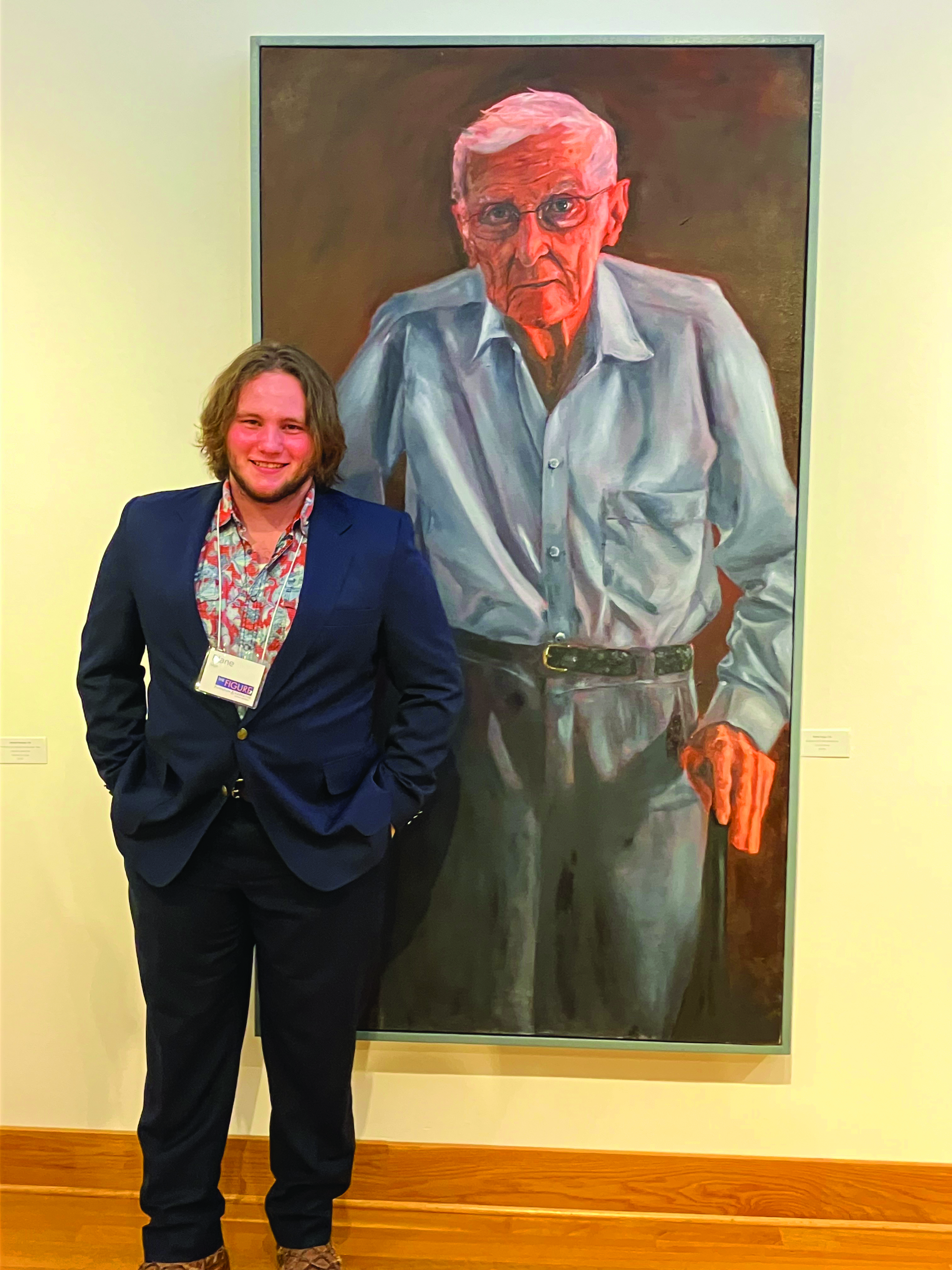
Blane Sage with his portrait, 'Mr. Crouse'
Blane Sage, Atkins, Virginia, has always loved making art. His piece in “From These Hills” at William King Museum of Art, Abingdon, Virginia, is a larger-than-life portrait of a World War II veteran from his series called, “Faces of Appalachia.”
“I’ve decided to file my art under the term ‘Hillbilly Renaissance.’ To me, that just means meaningful art created by folks in the Appalachian Region. The piece in the ‘From These Hills’ exhibit is part of a series that I started in my third year of college at U.Va. Wise. Starting in a student’s junior year, the art program at Wise requires each student to create a body of work each semester to be displayed in the campus gallery. This allows each student to be part of four total exhibitions at the college.
“The painting of Mr. Crouse is part of my series called ‘Faces of Appalachia.’ For the first installment, I photographed, interviewed and painted four veterans from the Appalachian Region. Mr. Crouse was the oldest of the four, having served in the Army during WWII. He was born and raised in Marion, Virginia, and he was drafted right out of high school. He told me that he served in the 104th Infantry Division of the Army aka the Timberwolves. He told me that he was part of the ‘Nightfighters.’ Upon doing some research, this is what I found about the Nightfighters: The Nightfighters of the 104th Infantry endured 195 days of constant combat in Germany toward the end of the war. The soldiers would often go into battle during the cover of night armed only with grenades and bayonets fixed to their rifles. This was partly to mask their location, and use the darkness to their advantage, as the flash from firing a rifle would give away their position. Another anecdote from my time spent talking with him was that he said he was only 18 when he was drafted, and he told me, ‘They all said that if you were 18, they wouldn’t send you overseas. But there I was.’
“I selected my models based on their connection to the Appalachian Region. Having strong ties to these mountains myself, I find it important to preserve the stories of the people who live here. I was extremely lucky to find Mr. Crouse. At the time he was the last living WWII Veteran in Smyth County. He passed away in January of 2025 at the age of 98. My other models were Eric Garrison, Harold Hagee and John Sage.
“I wanted to go for a larger-than-life feel with these paintings. That’s why each one is 6.5 feet tall. I want the viewer to see these figures almost as giants. People from Appalachia are often overlooked, and my goal was to bring these stories to the forefront of my work. I have recently expanded this series into a second installment featuring three Appalachian farmers. I plan to expand the series even more in the future,” Sage says.
His portraits are influenced by Baroque artists, such as Caravaggio and Gentileschi because of the dramatic lighting in their paintings. Sage works with oil paints and is hooked on portraits.
“I would draw all the time as a kid. I remember I was frustrated one day that my drawing didn’t look like my reference image, and my dad told me to flip my paper and the image upside down and work on it that way. For whatever reason, that unlocked something for me, and for years, I would draw with my paper upside down. When I got a little older, I found a love for drawing with oil pastels. I partnered with Wythe Hospice in Wytheville, Virginia, to gift oil pastel portraits to families that had had loved ones in the hospice program. Fast forward to August of 2020, I completed my first oil painting. Before then, I really didn’t enjoy painting, but after completing a portrait of Blaze Foley, I knew I was hooked. I started at U.Va.-Wise in August of 2021 with plans to become an art major. I chose oil paint as my medium, because I find it easier to work with. I tend to step back from my work a lot, so it’s nice to not have to worry about things drying too quickly,” he says.
Sage is inspired by music, which he listens to when he’s working. He is also inspired by biblical stories. In his junior year at U.Va. Wise, he painted the four horsemen of the apocalypse but instead of horses, he put them beside cars with model names that were horse related (Ford Mustang, Ford Bronco, Ford Pinto and Dodge Colt). Recently, he was inspired by the stories from the Appalachian Region.
“For me, being from these hills means that I am a part of a rich history of culture and tradition. I think sometimes people in Appalachia are forgotten about, but we always find a way to support one another and to thrive together. Being an Appalachian has taught me that community and family are very important. I don’t know where I would be without my support network, and I am so thankful to be from these hills,” Sage says.
For more information about Sage, visit www.blanesage.com.