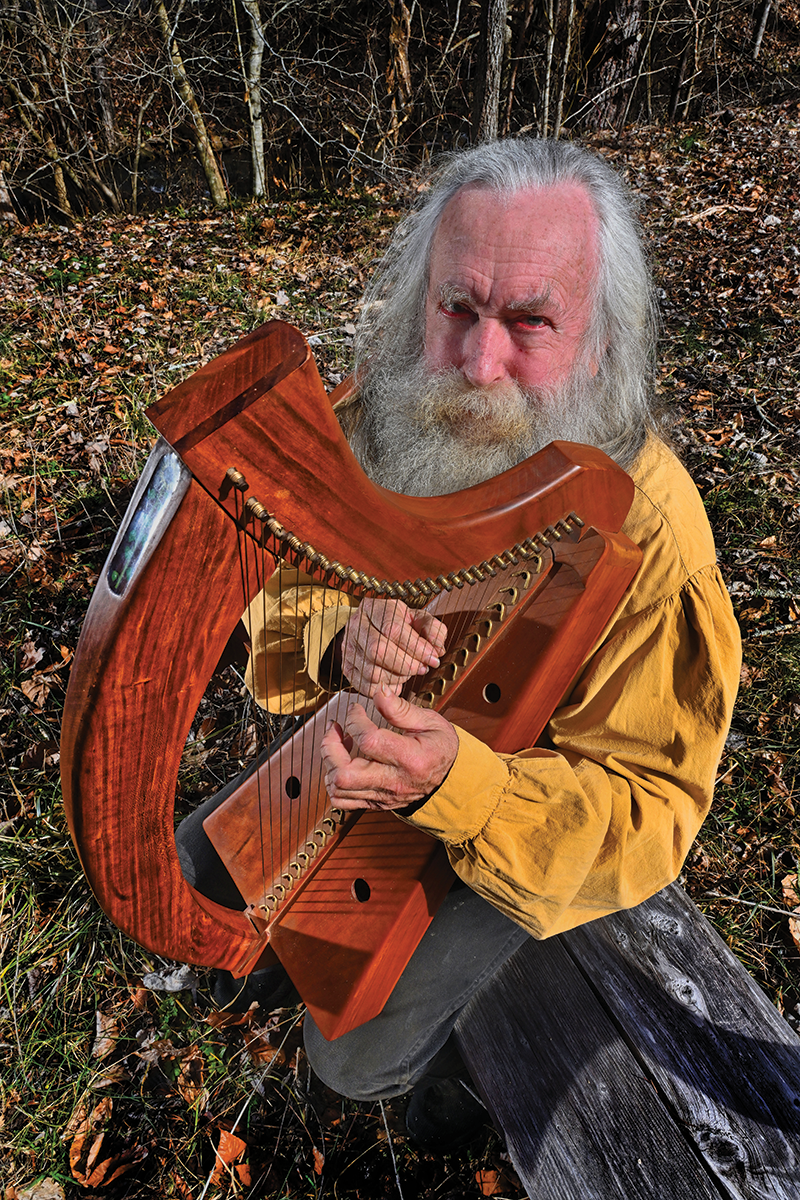
James Skeen (photo by David Grace)
“You will have heard that these instruments are made by a mad dwarf in a fabled shop underneath the bewitched mountain, that the wood comes from enchanted forests, and the metal is forged by otherworldly beings using charmed tools. The stories may have reached you that there are long-forgotten and forbidden rites attending to the stringing and tuning of the harps, and that they abide in veiled secrecy until the celestial orbs pass through favorable houses. And then and only then does the mad dwarf play a tune on each so etheric that it causes the cosmos to pause in harmony.
“Ha! Well, let us first disclose that this is not true. It’s pure fantasy. You see, we’ve heard him play, and he’s really not all that good.”
This the first insight you get about James Skeen, Bristol, Tennessee, if you visit his website, folcharp.com, looking for a harp.
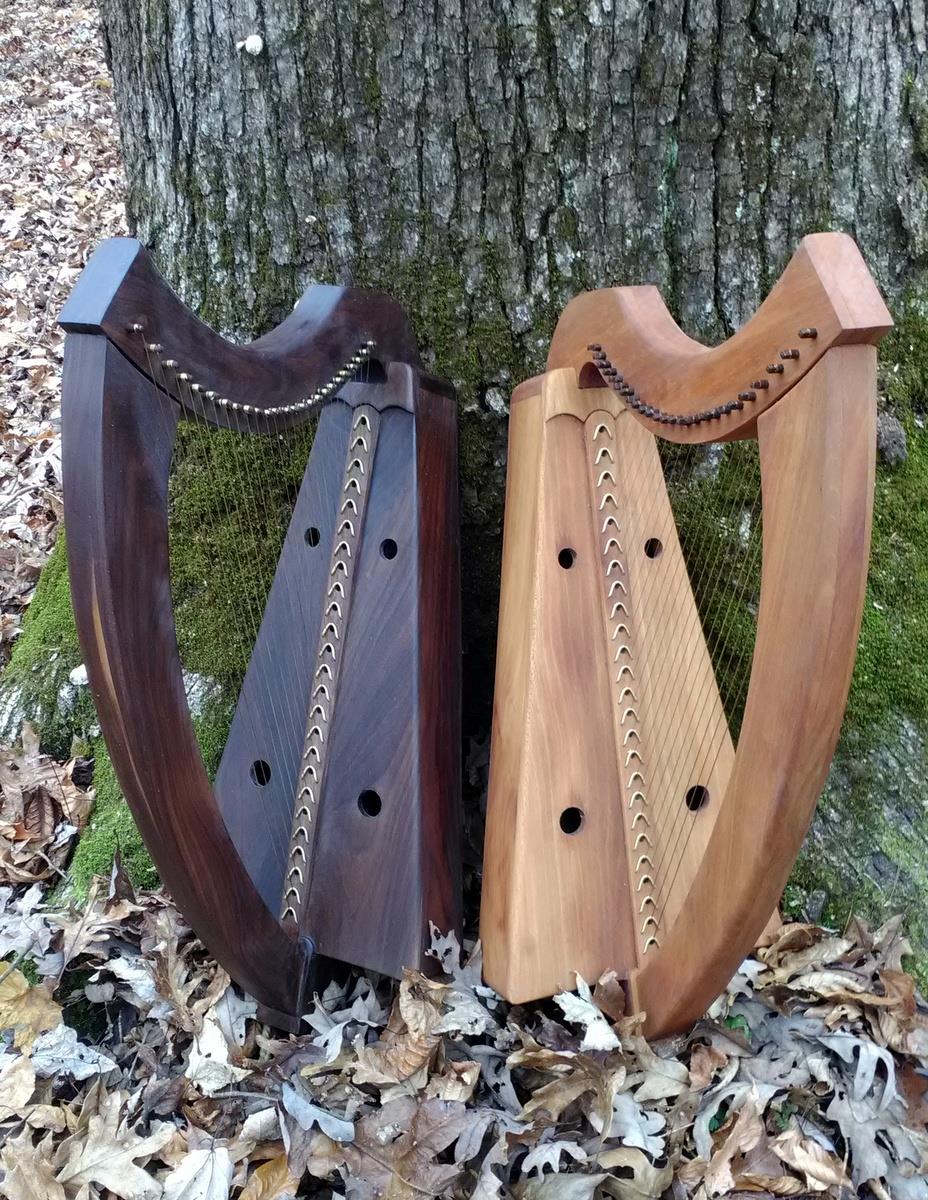
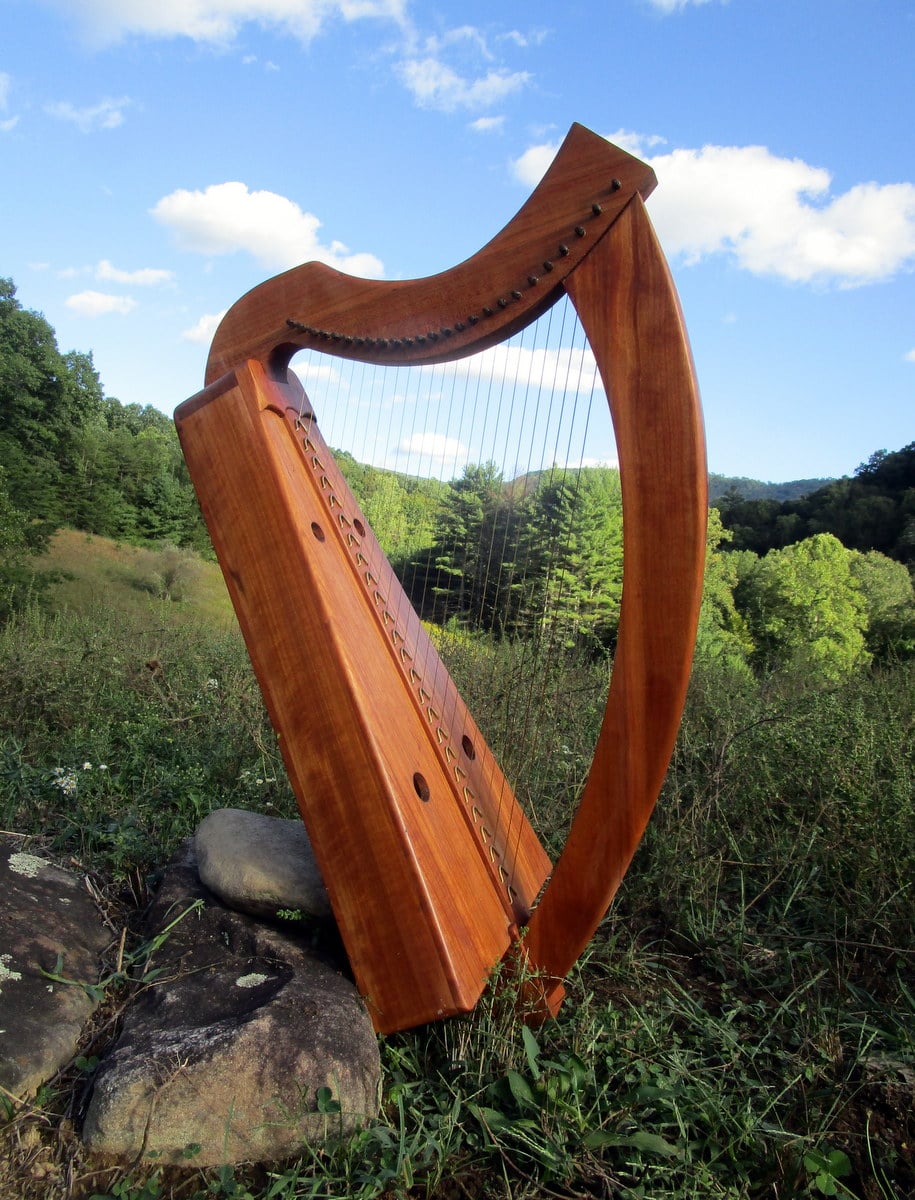
He builds Celtic, or Gaelic, harps which were popular from the 1200s until the mid-1700s. They are known in Celtic lands as a Clarsach. He has also made other historical instruments such as the rebec (bowed string instrument with a pear-shaped body), gusli (a multi-string plucked instrument from the zither family), citole (a flat-backed, plucked sting instrument) and kinnor (ancient Israelite stringed instrument, often called a lyre). More familiar instruments include mandolin, bouzouki, hammered and fretted dulcimers and others.
He learned to make these through research, correspondence with other makers, and trial and error.
“I have researched and corresponded with makers all over the world; there aren’t very many of us. So, my mentors are really patience and experience. I never met another harp maker face to face except the ones I help get into it,” he says. His sons are among those he’s helped get into harp making.
It’s difficult to trace where his interest began precisely, but he credits Joe Morrell’s music store on West State Street in Bristol.
“Joe had a collection of mysterious musical instruments on the walls, which later were displayed at his Grand Guitar Museum. The mystery was not wasted on me,” he says.
Skeen uses local woods, as the supply is plentiful. The tone wood needs to be a medium density and fine grained. Coniferous woods, oak and hard maple aren’t suitable. He uses soft maple, sycamore, black maple, sassafras, mulberry, cherry and others. He is particularly fond of sycamore. He gets his wood from local millmen and sawyers or from the loggers. Sometimes he uses old wood reclaimed from salvage.
The process starts with power tools to get the initial milling. After that, it is all done with hand tools. Skeens says antique stores are a good source for luthier tools.
When asked what’s distinctive about his instruments, he says, “Well, first they are brass-strung medieval harps that went into general extinction nearly 300 years ago, so, that alone make them rather distinct.”
But there are other distinctions. He uses no dyes or paints on the wood. It’s always the natural color finished with a natural oil (such as tung oil). This gives the harp a natural wood feel rather than a varnish or plastic feel. All the metal pieces (tuning pins, string shoes, toggles, etc.) are hand made in the shop.
He does not want to find out how long it takes him to make a harp. He says he set a timer once to see how much time went into one harp. “When the profit from the sale divided by the time spent went below $5 an hour, I quit counting and never did it again.”
But there are other perks — the people he meets.
“ I have met the most worthy and noble people one could imagine in the folk-harp world. I only have one thing on my bucket list, and that’s to buy the fellow maker/player Paul Dooley a beer. Then again, I’ve met a lot of other worldly folk drawn to the ancient wire-strung harp whom we affectionately call Moon-Bats,” he says.
He rarely takes specific commission work. “I build what I want to build, what amuses me, what I find fulfilling and then offer it for sale. I never take advance payments nor deposits. A person interested in any one type of harp asks to be included on the list and as each harp is completed, each person on the list is given the right of first refusal in order.
“The world of ancient harps is a very small world. If you gain notoriety in the field, at best you are a big fish in an exceedingly small pond. So, once a maker enters the scene, he becomes widely known ... among the aficionados. So, a website for the pics, a YouTube channel for demos, and yacking it up on various venues such as cosplay and reenactors has proven quite sufficient to market my wares,” he says.
Skeen has played with some local Celtic bands and plays with Hominy and Haggis. But he doesn’t play the harp with them. He plays other instruments.
As he explains it, “In the Disney flick, ‘Darby O’Gill and The Little People,” King Brian asks Darby if he would like to play the harp. Darby replies, ‘Ah, I’m no great hand at the harp.’ So, I confess that I am a graduate of the Darby O’Gill School of Harping. That said, I have a series of demonstrations of most of the harps I’ve made on YouTube. The wire-strung harp you say? Is it hard to learn to play? Yes and no. In 20 minutes, I could have you playing a tune even if you’ve never touched even one musical instrument in your life. And after that if you live a very long life and pursue the interest with enthusiasm, you will not have begun to scratch the surface. Did I mention it’s mysterious?” Skeen says.
If you wish to see more of his harps, visit www.folcharp.com.