'The Neighbor's House with Fireflies'
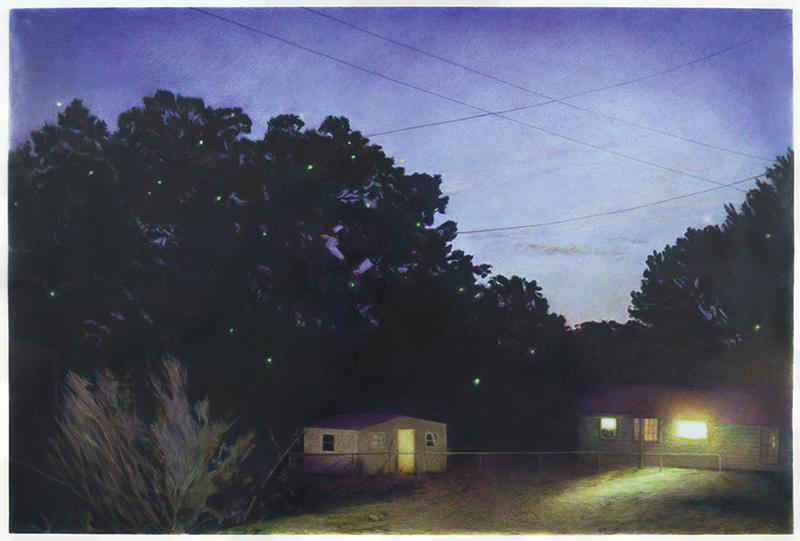
Jessie Shinn’s piece in the “From These Hills” exhibit is “The Neighbor’s House with Fireflies,” a colored pencil drawing.
The juror, Kathy Keilsey Foley, describes it as “hauntingly beautiful.” Shinn says, “This piece is one of several I have doneof myneighborhood. We often walk at twilight, and there is a sense of magic in that time, especially in the summer when the fireflies are drifting up into the trees. Seeing the lit windows of the neighbors’ houses, there is that tension between inside and outside, belonging and not belonging, knowing your neighbors and being strangers. My work is about the emotional charge of place — the way light, shadow and shape can make the familiar and ordinary feel mysterious — where intimacy and strangeness overlap,” she says.
She was encouraged to make art when she was a child, because her mother is a fiber artist. Shinn drew and painted as an adult but didn’t take it seriously until her children were grown. At that point, she went back to school and got a Master of Fine Art degree.
She has worked in many mediums— painting, printmaking, ceramics and photography, but drawing was always the center of her work. “During Covid, I found myself with a lot of time, and I decided I wanted to slow things down, so I went back to pencil drawing. I was just working in black and white for several years, but I began to miss color. Colored pencil drawing allows the same slow layered build-up of shape, form and light, with all the added possibilities of color,” she says.
She became a full-time artist when she was in her 30s. “I didn’t feel satisfied with the work I was doing. I knew I wanted to work creatively, and to say something, but in a way that was more subtle and ambiguous then what I could put into words — I’ve tried poetry too. If I had any musical ability I would have gone in that direction — music is such a direct way to speak to the deeper stuff — but for me visual art has been the best way to explore and communicate the things I am interested in,” she says.
She is inspired by mystery, confusion, ambiguity and wonder. Place plays an important role in her work. She feels that places can be both intimate and familiar, and deeply strange and mysterious at the same time.
“Light and darkness are important. They play such a big part in our ideas and emotions around wonder, mystery and fear. I am also interested in the ways we see or sense the presence of other people even when they aren’t directly visible. All these things inspire and drive my work, as well as the materials themselves. I get really excited playing with different kinds of paper and seeing how the media responds to it.
“I am relatively new to Appalachia — we moved to Asheville four years ago — but I feel deeply connected to this place. One thing that feeds my love of ‘these hills’ is my hobby of trail running. I’ve spent so much time all over the Blue Ridge and in Pisgah National Forest, just alone on trails in the woods. Another experience that solidified my attachment to Western North Carolina was Hurricane Helene and the extended period afterward when we were without power, cell service or potable water. The way neighbors and the larger community came together, the care and love extended by everyone to help each other through that time, was amazing to experience. Finally, because my work is largely about place, drawing itself has taught me about and built my connection to where I live. While working on a drawing I become very close to the particular — the curve of a tree limb, the lean of a street sign, the way a shadow falls at a certain time of day or season. So, each time I come back to a place I’ve drawn there is this surge of recognition and warmth,” she says.
Her influences are Andrew Wyeth, Bo Bartkett and the photographer Uta Barth. She is also excited by a Norwegian artist, Oda Sønderland.
“Like most artists, when I am working on a piece it is largely about myself — working on ideas and imagery I am interested in, with materials I love, seeing what resonates with me as the work evolves. When the work is finished there is always the hope that it will evoke something for someone else. When that happens, when something so personal holds meaning for another person, it is really gratifying. That connection is what art making is all about,” Shinn says.