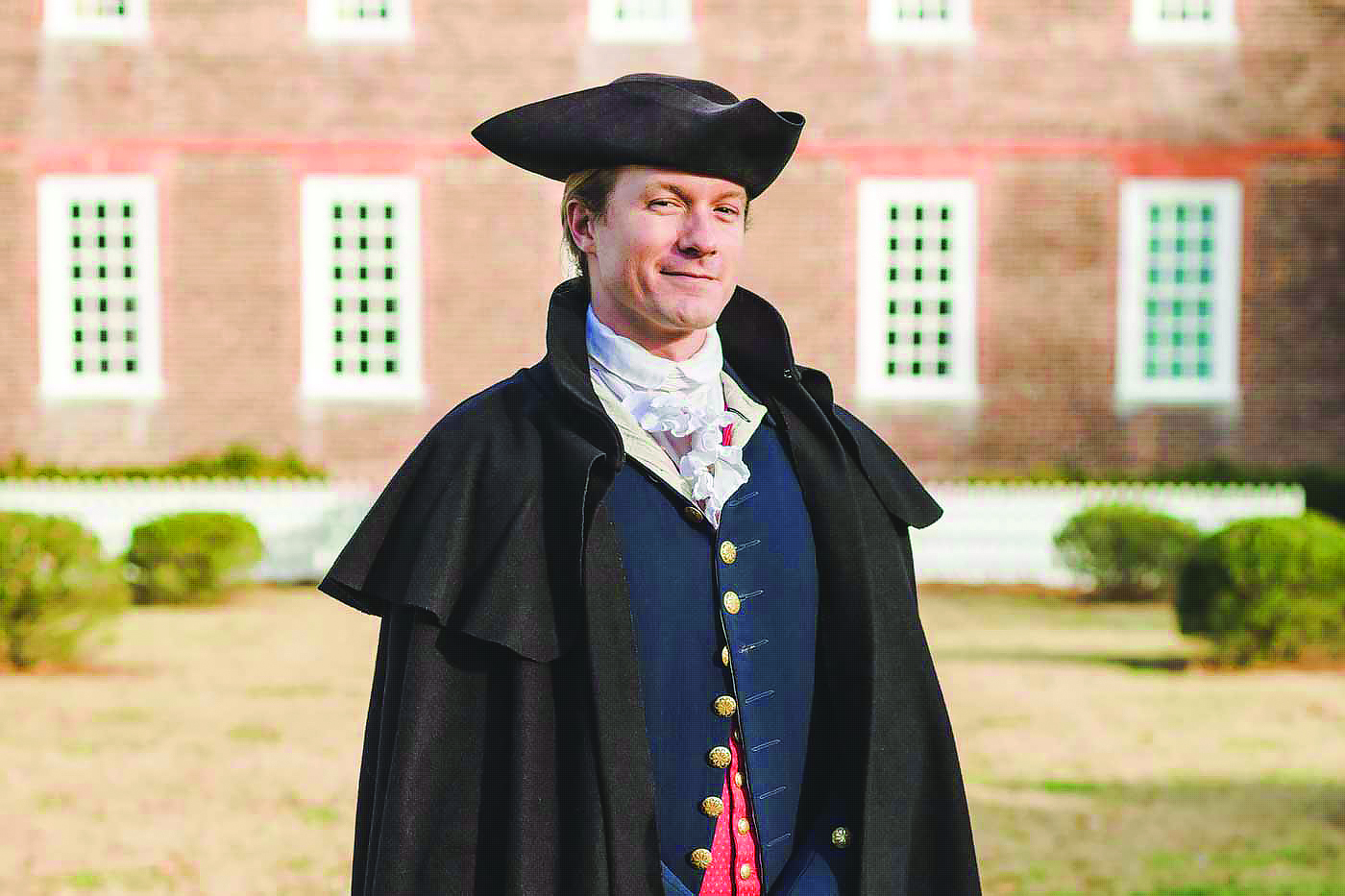
Kurt Smith as Thomas Jefferson
For the past six years, the Historical Society of Washington County has brought historical interpreters of Thomas Jefferson and one of his contemporaries to the Virginia Highlands Festival to carry on a “conversation” with the locals, as if they were transported back 250 years.
This year Kurt Smith and Ron Carnegie from Colonial Williamsburg bring Thomas Jefferson and George Washington to life in a “conversation” on two successive evenings at the Martha Washington Inn & Spa, Abingdon, Virginia.
Our area’s connections with Jefferson and Washington are numerous. Jefferson served as Secretary of State in Washington’s administration and helped forge the structure of our nation’s government and economy. Thomas Jefferson’s father, Peter, played a pivotal role in surveying the western lands where Abingdon now stands, piquing his son’s lifelong interest in the western frontier — a passion shared with George Washington. Washington County, Virginia, was created in 1776 — one of the first counties established by the newly independent Commonwealth of Virginia —and named in honor of Gen. George Washington.
And for almost two centuries, the building in which they will be performing has been associated with the name of America’s first First Lady, Martha Washington.
Tickets are $25 per person and are available online, at the Historical Society located at 341 West Main in Abingdon, and at the door until sold out. One child 12 or under can attend at no cost when accompanied by a paid adult. The doors open at 5:30 p.m. each evening, with a cash bar, and the program begins at 6:30 p.m. Sunday, July 26, and Monday, July 27, at the Martha Washington Inn Ballroom.
Smith took time out of his busy schedule to talk to us about his work.
A! Magazine for the Arts: How do you research your characters and the historic event they are discussing?
Smith: The work we do is based entirely in primary source material, and as someone who portrays Thomas Jefferson, there is plenty of source material to draw from. I have over 50,000 letters in the “Papers of Thomas Jefferson” at my disposal to draw from. That is my script. My job is to read his words from his letters and memorize them so that I can create improvised and spontaneous conversation. The goal is to allow any guest in front of me to walk away with the feeling that they just had a real conversation with Thomas Jefferson. Most actors are accustomed to receiving a 60-page script. I just happen to have a script that is 50,000 letters long.
A! Magazine: How do the two of you work together?
Smith: Ron Carnegie and I have worked together for the past 11 years as George Washington and Thomas Jefferson. By now, we have engaged in this work alongside each other for long enough that we have that gift which time and proximity allows: trust. Usually, we will pick a topic and then pass the ball back and forth to each other in a live extemporaneous way. I know, and trust, that he will bake into that improvised conversation, Washington’s opinions and quotes, and he knows that I will do the same. Also baked into that conversation will be other more nuanced methods of storytelling: The fact that he is my elder and thus as Thomas Jefferson, there is an 18th century expectation of deference to him. The fact that, depending on the year in which we set the conversation, our relationship might look different. For example, if the theme were about federal power, my answers to him might look a bit different if we set the scene in 1789 versus 1799. When viewed in that way, part of the joy of this work is not only discovering the topic upon which we are to speak but the year in which we are to speak it.
A! Magazine: How did you get into this and how do you decide on the historic events you’ll portray?
Smith: Every colleague I have who does this work on a full-time basis has been introduced to it in a slightly different way. For my part, Thomas Jefferson came to me. I did not seek him out. I was working as an actor in New York City when, out of the blue, a colleague I had attended graduate school with sent me an email with an application to audition for Thomas Jefferson. The email was not guaranteed, nor was the audition, but I found Jefferson to be extraordinarily fascinating. After reading a handful of books, I attended the audition, and the rest is history. It is a rare experience to be given the opportunity to dig into one human to such depth and for such a length of time. Jefferson came to me; I read him daily, and he continues to educate me on a daily basis.
A! Magazine: What’s the greatest challenge in historical interpretation?
Smith: I will speak to this as an interpreter of Thomas Jefferson. One of the greatest challenges that is mantled with this role is to navigate the icon versus the man. Over the past several generations, Thomas Jefferson has received mythic status in American history. Occasionally, that myth carries with it negative connotations and occasionally deified connotations. Neither are useful. My job is to present Thomas Jefferson, the human, period, with all of his faults, all of his quibbles, his eccentricities, his paradox, his brilliance, his hopes, his fears and his faults. When viewed in that way, the most difficult part of interpreting him in the 18th and early 19th century is to present him to a 21st century audience.
A! Magazine: How often do you change the topic?
Smith: I change topics constantly. Whether it’s Jefferson talking about his fights with the Supreme Court, his understanding of constitutional law, his writing of the Declaration of Independence, doubling the size the country, fighting pirates, serving in France for five years or having a vice president who had murder charges in two states. There is no end to the topics which I can discuss as Thomas Jefferson. I find myself occasionally choosing topics for one of two reasons: Either, it’s because there is a theme running through our current fabric of American society that citizens are desperate to speak on and hear about, or it’s simply because I’m tired of talking about one subject and want to talk about the other 50,000. Nobody asks questions about Jefferson as a single father, but he was. He was a single father of three girls and then two and then one, but most people want to talk about the big political movements, and in that way just by their line of questioning, they have already stripped the humanity from him. I like bringing that humanity back, and if that means changing the topic, then I will.
A! Magazine: How often do you perform? Where do you work when you aren’t on the road?
Smith: I perform five days a week at Colonial Williamsburg. In addition to those five days, I perform around the country and around the world. From England to France to Abingdon, Virginia, my goal is to present Jefferson in a human way to as many humans as possible. I have worked for the Colonial Williamsburg Foundation for the past nearly 11 years and my job in that time has been singularly focused on one man: Thomas Jefferson.
A! Magazine: What do you use for primary sources/secondary resources?
Smith: Princeton University started a project in 1950 to compile and annotate all of Jefferson’s letters. They started that work in 1950, and at the time of this printing, they are still continuing that work. It is a heavy lift. It took me about eight years to read through all 50,000 of Jefferson‘s letters, but the work is never complete. Complete. I can read the same letter 12 times and find 12 new additions and interpretations and discoveries within that letter. Add into this, the newspaper articles that Jefferson was reading from the Pennsylvania Gazette to the Virginia Gazette to the books, the thousands of books, that he read from natural philosophy, to botany, zoology, chemistry, astronomy, anatomy, languages, of which he read, spoke and wrote seven. Religion. Slavery. The role of the federal government. There is no end to this work of discovering Thomas Jefferson, and I am quite happily situated in a role where I can continue to discover him for decades more.
A! Magazine: How did you get involved with this? What interests you about it?
Smith: As I mentioned earlier after leaving graduate school in Iowa, I moved to New York City to work as an actor. Several fruitful years in New York City brought me to this experience. A colleague that I had attended graduate school with, though he was in the directing department, and I was in the acting department, brought me to this work. I have since found it to be incredibly fruitful when discussing the paradox of what it means to be a citizen in this society that we have mutually agreed upon.
I am interested in exposing the crystalline fact that every bit of power we give to the founders, we should also give to ourselves. And with that power comes the ability to fail. The future will write about our failures. Trust me, I know.
A! Magazine: Costumes. Where do you get them? How historically accurate are they? Are they specific to the period or to the person?
Smith: My costumes, which number about a dozen, vary to accurately represent the exact time that I wish to portray. I have costumes that fit Jefferson in 1770 that are accounted for in portrait. I have costumes that fit Jefferson when he’s in France but are also accounted for in portrait. The same for when he is an executive as vice president and president. The audience might not know that I am not just accurate down to the quote but down to the stitch. But I know. And that accuracy matters.
My costumes are provided by a brilliant team called Historic Clothing and Dress at Colonial Williamsburg. While I ensure that I am accurate down to the quote, they ensure that I am accurate down to the stitch. They do incredible research into portraits and include Thomas Jefferson‘s memorandum books which account for what cloth he is buying and then re-creates that accuracy into the habiliments that I have the fortune to wear.
A! Magazine: Do you see yourself more as an actor or a historian?
Smith: My background comes from acting. My job, always, is to present truthfully the person you see in front of you. Whether it is Hamlet, or Thomas Jefferson, I cannot digest either “actor” or “historian.” You must have both to do this work. To remove one, to engage in this work, I cannot simply be an “actor” and do this work.
Equally, I cannot simply be a “historian” and do this work. You must have an appetite for research to be a bulldog historian and then allow yourself to bear open your chest in unabashed truth on stage and present in an honest, open and truthful way this work. To do this work well requires both actor and historian.