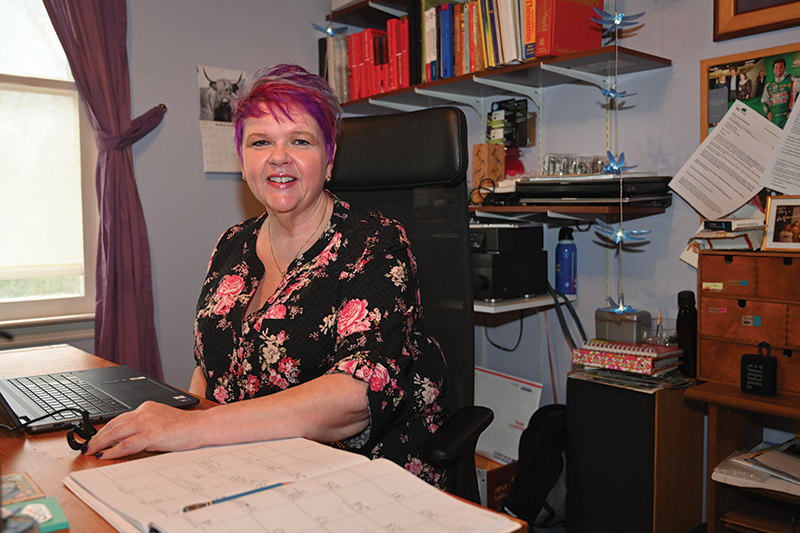
Chrissie Anderson Peters (photo by David Grace)
Chrissie Peters began writing poetry to cope during a traumatic period of her life.
“In fourth grade, my mom was going through a really bitter divorce in my hometown. We were being stalked. She received daily death threats from someone claiming to be my stepfather’s lover. It was really ugly.
“I needed a way to process not being the number one focal point in her life and the fear I felt, so somehow, I just started writing little rhymes. My fourth-grade teacher, who was probably aware of my home life — I think, in a small town, most teachers know somehow — pulled me aside the day I showed her my first poem, and told me it was wonderful, to keep doing what Iwas doing, and I would get better and better at it. I wrote my first song that year and sang it for the 4-H talent show.
“Without Miss Bourne’s constant encouragement, I’ve always believed I would have gotten lost in my mother’s psychological traumas that year, and I’m not sure what would have happened to me. But I went to a small elementary school, North Tazewell Elementary, that spun a safety web for students about to fall through the cracks and reached out for us to help us hold on and thrive.
“My fifth-grade teacher, Mrs. Betty Yates, continued the process, and, unbeknownst to me, took my writing to high school English teachers, asking how to keep me engaged, how to challenge my writing so I would continue it and not get bored. These women built the very foundations of my love of writing and reading — and to write, you have to read. They fed me everything they could, everything they thought I would enjoy.
“They introduced me to the classics and let me explore on my own, especially Mrs. Yates. In fifth grade, she somehow arranged for an Appalachian author to visit our classroom, David Huddle. I became inspired. If someone else from the area where I lived could become ‘a writer,’ then surely, I could, too. I remember reading his work early on. And Edgar Allan Poe. Especially Poe. He was weird. I felt weird. I really identified with Poe in late elementary school,” she says.
Peters started writing poetry specifically because she thought it had to rhyme and rhyming was an easy goal. She had stories, and she writes stories in her poetry, so she thought she just needed to add rhymes. As time passed, she added short stories and nonfiction. But, poetry and song lyrics were where she turned when she needed comfort and reassurance. They helped her deal with her feelings and frustrations. She’s also since learned that poetry doesn’t need to rhyme.
She has taken classes and workshop experiences throughout her writing life. The Appalachian Writers Workshop in Hindman, Kentucky, has influenced her as an adult. Her most recent workshops are Table Rock Writers Workshop in Little Switzerland, North Carolina, and the Highland Summer Conference in Radford, Virginia. She holds a bachelor’s in English/Education from Emory & Henry University, Emory, Virginia. She received her master’s in information sciences from the University of Tennessee. She is a librarian at Northeast State, Blountville, Tennessee.
“My advisor/mentor at Emory & Henry introduced us to Affrilachian poet Frank X Walker and Appalachian poet George Ella Lyon. I wasn’t comfortable with my Appalachian-ness then, still fighting to get away from everything I thought it symbolized, still trying to cover up my accent. I read the required authors in high school and college but was still mostly writing my own story or other people’s stories. I remember friends paying to write songs about them and their boyfriends. I made $2-$5 for each song. That was a pretty good living for a poet in the ‘80s.
“The influences became more Appalachian as time went on. We speak the same language. With variations of the same accent. These days my biggest influences and mentors are Denton Loving, a Tennessee poet and friend; Annie Woodford, a North Carolina poet and friend, transplanted there from Virginia; George Ella Lyon, a dear friend/mentor who is also a former Poet Laureate of Kentucky; Connie Green Jordan, an Eastern Tennessee poet/friend who taught a nine-month poetry chapbook class I took; and Sue Weaver Dunlap, another Eastern Tennessee poet/friend, who has taught me much about lineation, organizing poetry and ordering poetry for a collection. Andy Fogle, the poetry editor for the online journal Salvation South is another mentor/friend willing to teach me the finer points that add up to the greater nuances in poetry. I’m blessed to have a plethora of friends who are also mentors,” she says.
She writes mostly free verse because it gives her freedom. She occasionally writes in other forms, such as Fibonacci or a sonnet. Her favorite themes are Appalachia, family, loss, survival and perseverance.
“My writing process is messy. A bit undisciplined. I write ideas on snippets of papers, napkins whatever is handy when it hits me — the notes section of my phone. Sometimes I go home immediately and work on it. Sometimes I run across it months later but still get that same jolt of energy and know it’s worth pursuing. I try hard to key everything into my computer, even as a rough draft. I’m horrible to leave things in longhand and never convert them, never do anything else with them. Some poems come out nearly finished in one take. There have been times when it has taken me two to three years to ‘finish’ a problem poem. And there are some, I’m never convinced are quite completed,” Peters says.
Her work has been published in a variety of places. Some examples are Clinch Mountain Review, Jimson Wood, Pine Mountain Sand and Gravel, Still, Red River Review, Untelling, Critical Humanities and Salvation South. She won the poetry award through Wytheville’s Chautauqua twice and first place in poetry for the John Fox Festival Writing Contest. She has two books coming out next year: a chapbook of poetry titled, “Knowing How to Lose & Other Poems” and a collection of short stories tentatively titled “Miles Away from Nowhere.”
She is a member of the Poetry Society of Tennessee and encourages poets to find out more and use its resources.
Her website is www.CAPwrites.com.
Memory-Go-Round
“It’s hard living life on this memory-go-round.” – “Goodbye,” by Night Ranger
I spent last night on a memory-go-round,
childhood conjured from cobwebbed corners,
places I hadn’t been in forty-five years,
places I hadn’t dared think I’d ever go again,
transported through legends muddled in books,
mountain superstitions my heart held onto
when I thought my mind released them long ago:
I danced with ghosts I scarcely remembered,
souls who molded me into who I became
through their kindness, courtesy, curses, and cuts,
all the ways one gets shaped and made over time,
because it’s the good and the bad that cast us.
Published in Critical Humanities, Volume 4, Issue 2, 2025
(reprinted with permission)