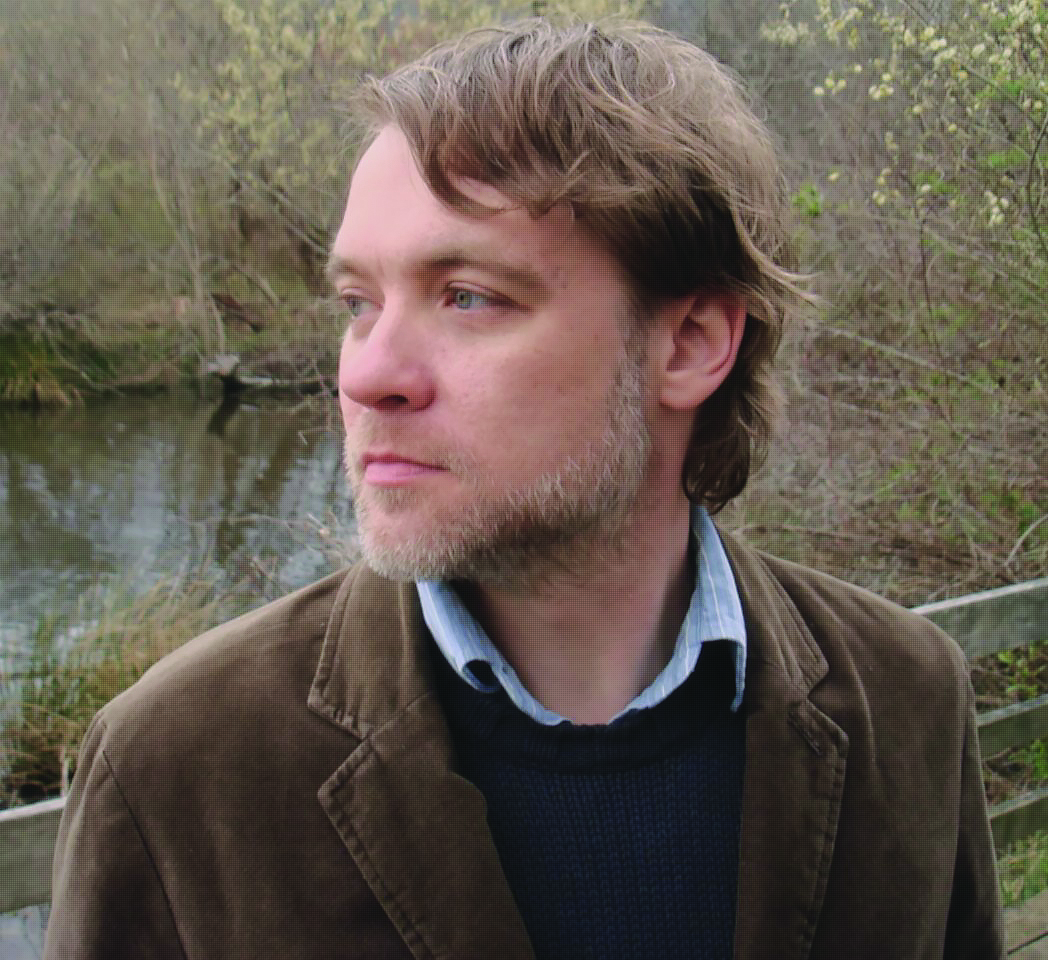
Jesse Graves
Jesse Graves says in some ways he’s always been writing poetry.
“I loved music growing up and my first attempts at writing were intended to be songs, but I didn’t really have much musical talent. I was also a lot younger than my siblings, so a lot of my childhood games were played by myself, and I would create these intricate narratives to go along with my plastic army men, or Hot Wheels cars or my baseball cards. I may have attempted a few poems in high school, but it wasn’t until college, when I first read poems by Wendell Berry and James Wright that related to the people and places I had known, that I began to really try writing my own. What I discovered then was that poetry was still alive and well, and vital to the lives of people all over the world,” he says.
He does write in other genres. He published a book of essays a few years ago, “Said-Songs: Essays on Poetry and Place,” and has written some fiction, which he has never published.
“Most of my ideas for fictional stories end up in poems, and I think that’s mainly because the poems I write usually have more of a narrative style. Something about the compression and the focus on sound and imagery in poetry just feels more natural to me than other ways of writing.
“That poetry includes so many different styles and approaches is what I love most about it, but poems about landscape, family life and plants and animals have almost been the most interesting to me. Robert Frost and Walt Whitman are the poets I have come back to most often, different as they are from one another, because they each mastered some essential element of poetry for me. With Frost, I love the convergence of common speech within a perfectly built structure, and I think of him as the master of the craft of poetic form; and with Whitman, it is the expansive vision for life and the world around us, in a language that just soars and sings. I try in my own modest way to emulate what I find in their poems.
“Most of my poems are written in free verse, though I do love rhyme and meter, and the more traditional elements of poetry. I find myself using these techniques more and more and have published a few sonnets lately, which is sort of the ultimate test of skill for poets. In a sonnet, you really only have 14 lines and 10 syllables with five stressed beats to work with, 140 syllables total, if you are strict with the form. I love a well-made thing, especially when it is made by hand, something that feels built to last, and good poems have all those qualities to them,” he says.
He has studied with teachers and mentors throughout the years. His first was high school English and history teacher, Kenneth Venable. He had a great professor named David Worley in his one year at Lincoln Memorial University, and several poets who were his teachers at the University of Tennessee — Connie Jordan Green, Marilyn Kallet and Arthur Smit — whom another professor there called his “poetry guru.” Then he went to Cornell University in Ithaca, New York, for a Master of Fine Arts degree in poetry writing, where he was fortunate to study with Robert Morgan, who became a dear friend and mentor. They are in touch several times a week, and he has rarely made any big decisions about writing, or life in general, without asking for his thoughts about them.
Graves is an English professor and poet-in-residence at ETSU, where he has taught since 2009. He teaches poetry writing, alongside British and American literature. This summer, he teaches a poetry workshop at the Appalachian Writers’ Workshop in Hindman, Kentucky, and for the Appalachian Authors’ Guild in Abingdon, Virginia. He also directs the Bert C. Bach Written Word initiative at ETSU, which brings in guest writers and hosts literary events on campus. He often gives readings and guest lectures at other universities. He speaks April 18 at 3 p.m., at the Washington County Public Library in Abingdon, Virginia. “I would love for people to browse our website (www.etsu.edu) and join us for our 10th anniversary Spring Literary Festival, April 21 and 22.”
“There is no place where I would rather work. I grew up in rural East Tennessee, in a small farming community called Sharps Chapel, where my German ancestors settled in the 1780s, so it is very meaningful to me to share my learning and experiences with students so near to my home country.
“I have written about my homeplace from my earliest poems to my most recent, what William Faulkner called his ‘little postage stamp of native soil.’ I have always been inspired by the land of Sharps Chapel, and for me, something magical happens in literature when people and their land come together either in communion or conflict.
“The English poet and novelist Thomas Hardy is my favorite writer, and he does that convergence better than anyone. Appalachian writers seem especially gifted at it as well. I have always written about my family, from my parents and ancestors to my wife and daughter, and these relationships continue to inspire me. I love animals and trees, books and paintings, music and old trucks — all these things have appeared in my poems, all the people and places closest to my heart.
“I try to write first drafts quickly, then revise slowly and deliberately. I tend to over-write on first drafts, somewhat by design, because if you are writing in that special glow of inspiration, it feels important to get down everything you are thinking or perceiving in that moment. When you have an image or an idea, you are likely close to something that may be hard to get back to if you don’t take it all in while you are there. Anything that doesn’t work or doesn’t fit can be taken out in the revising process, which I appreciate more the longer I work at this craft,” Graves says.
He has six poetry collections, including “Tennessee Landscape with Blighted Pine,” “Basin Ghosts, Specter Mountain” (co-written with William Wright) and “Merciful Days.” He has two forthcoming poetry books, “A Little Light in the Grave” (co-written with Larry D. Thacker) and “Across the River of Waking Dreams.”
He received the James Still Award for Writing about the Appalachian South from the Fellowship of Southern Writers and the Philip Freund Prize in Creative Writing from Cornell University. Berea College and the Appalachian Studies Associated granted his first two books the Weatherford Award in Poetry and Morehead State University gave him the Thomas and Lillie D. Chaffin Awards. He was inducted by the Friends of Literacy into the East Tennessee Writers Hall of Fame and the ETSU College of Arts and Sciences presented him with their Distinguished Research Award.
“I am a night owl by nature and have written a lot more of my poems closer to midnight than noon, but I also love the early hours of the morning, when the birds are most active and vocal. I try to be open and flexible in my writing process, not too fixed on any set time or place for writing, and I try to keep a variety of pens, notebooks and even a couple of old typewriters around to vary my process.
“Probably the most important discovery in my writing process happened nearly 20 years ago, when my dear friend William Wright asked me to join him and a couple of his old friends, James Clinton Howell and Dan Morris, in what they called a ‘poetry marathon,’ where we would write a poem every day for a month and share them by midnight through email. We didn’t offer any comments or feedback, as there simply isn’t time for that, and the drafts aren’t ready for it anyway. It is a purely generative project, and I think it transformed my approach to poetry, and made it more of a daily experience than it had ever been. We just finished up a marathon on March 1 and have done a few of these each year for all this time, so I have made a much more thorough record of my world in poems than I ever would have without this process,” he says.
For more information, visit jesseegravespoetry.wordpress.com.